Polycyclic aromatic hydrocarbons (PAHs) are compounds containing two or more benzene rings[1]. They are recognised as the main organic pollutants affecting human health because of their toxicity, genotoxicity, mutagenicity and carcinogenicity, which can damage the respiratory, circulatory and nervous systems as well as the liver and kidneys.
PAHs come from natural and artificial sources. Natural sources include biosynthesis by land/aquatic plants and microorganisms, plus volcanic eruptions, fossil fuels, lignin and natural fire residues — the natural background is about 100–1000 µg/kg in soil and 0.1–0.5 ng/m³ in air. Artificial sources are mainly incomplete combustion of fossil fuels (coal, oil, gas), wood and paper, or pyrolysis under reducing conditions[2].
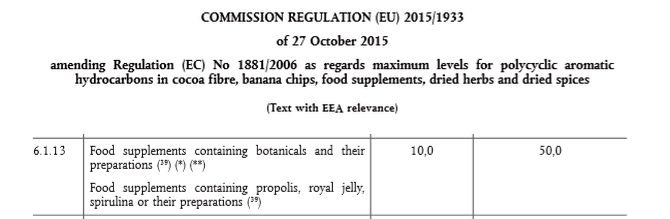
Due to the influence of soil, atmospheric environment and self metabolism in the process of planting and production, plants contain not only the main functional components, but also traces of harmful substances, such as PAHs, which have attracted more and more attention form people in the food industry, as human's continuous pursuit of healthy quality to life. The "COMMISSION REGULATION (EU) 2015/1933 of 27 October 2015" issued by the European Union in 2015 made new regulations regard to the maximum levels of PAH 4 in food additives containing plant extracts, in which required level of Benzo(a)pyrene, one main compound of PAHs, shall not exceed 10µg/kg, and the total amount of PAH 4 shall not exceed 50µg/kg[3].
The European Union's Commission Regulation (EU) 2015/1933 sets maximum levels for PAHs in food additives containing plant extracts:
| Parameter | EU maximum level (2015/1933) |
|---|---|
| Benzo(a)pyrene | ≤ 10 µg/kg |
| Total PAH4 | ≤ 50 µg/kg |
As PAHs compounds appear widely in soil and atmospheric environment, some of them may be mixed with solvent and enter the extract while extracting, thus polluting the plant extract.
In view of the above mentioned, we developed a treatment aiming to remove the harmful components including PAHs, which has been verified strictly by methodology and by which the level of PAHs is compliant with the EU standards in the premise of ensuring the natural active ingredients of astragalus extract are free from loss;
We compared the PAH levels of astragalus extract sold on the market with KING-TIGER's processed extract.
Market sample (without PAH-removing processing): Benzo(a)pyrene 36.2 µg/kg (limit 10 µg/kg); total PAHs 239.4 µg/kg (limit 50 µg/kg) — 3 to 5× above the EU limits.
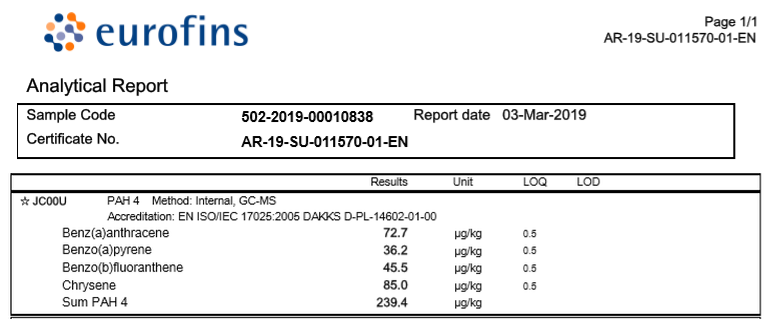
We developed a treatment that removes harmful components including PAHs, verified rigorously by methodology. The process reduces PAH levels to EU-compliant values while ensuring the natural active ingredients of astragalus extract are not lost.
KING-TIGER (with PAH-removing processing): Benzo(a)pyrene < 0.5 µg/kg; total PAHs 0.7 µg/kg — compliant with Regulation (EU) 2015/1933.
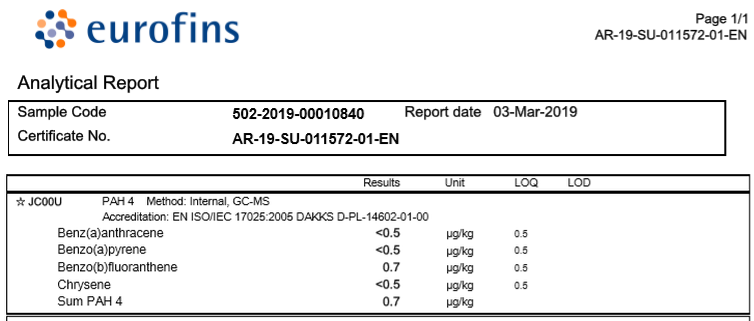
| Parameter | EU limit (2015/1933) | Market sample | KING-TIGER (after removal) |
|---|---|---|---|
| Benzo(a)pyrene | ≤ 10 µg/kg | 36.2 µg/kg | < 0.5 µg/kg |
| Total PAH4 | ≤ 50 µg/kg | 239.4 µg/kg | 0.7 µg/kg |
Need PAH-compliant astragalus extract with third-party report and CoA?
1. Xie Xin, ORGANIC CHEMISTRY. Chongqing University Press, 2015: 71-75.
2. Wang Xiuling, Cui Ying. ENVIRONMENTAL CHEMISTRY. East China University of Science and Technology Press, 2013: 150-151.
3. Commission Regulation (EU) 2015/1933 of 27 October 2015 amending Regulation (EC) No 1881/2006 as regards maximum levels for PAHs in cocoa fibre, banana chips, food supplements, dried herbs and dried spices.
4. Commission Regulation (EC) No 1881/2006 of 19 December 2006 setting maximum levels for certain contaminants in foodstuffs.